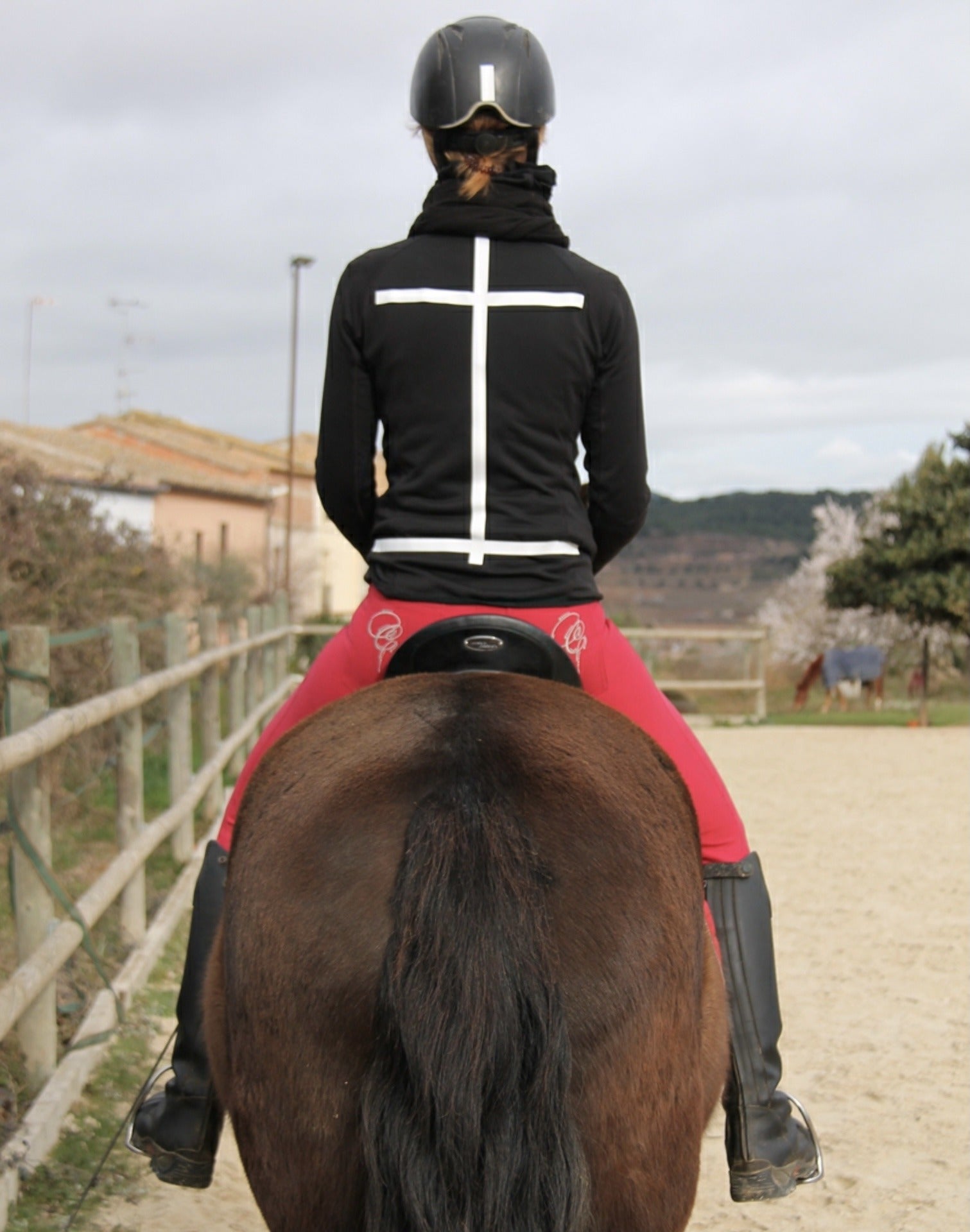
A horse's back is not developed for us to ride on, however, since we do, we must be aware of how we can influence it, and the horse in general.
Loss of performance, "lazy" feet, being more "flexible" to one side than the other, etc., can be signs that we are negatively influencing our horse.
To make it more understandable...
Imagine carrying a backpack that is heavier on one side than the other...if it's just for a short while, nothing happens, but in the long run, it ends up causing compensations in our body and our biomechanics (we lean to one side to compensate for the weight, for example);
or that in that same backpack, things are not "organized" and the corner of a book pokes into your back and causes you pain. We try to avoid it by compensating with our body.
IMAGINE THAT IN THAT BACKPACK YOU ARE CARRYING SOMEONE WHO MOVES, AND HAS THEIR OWN BIOMECHANICS, AND THEIR OWN "BODY ALTERATIONS" ....
Horses are relatively moldable and adapt to us as much as they can, but sometimes we exceed their ability to adapt to us and we encounter problems such as those mentioned above.
After all, we are a binomial of living beings, so what we do will influence them and vice versa.
Something very simple to see would be the placement of the pelvis:
Indeed, this is the control center of movement, so it will have a decisive influence on the rest of the body. Depending on how I place my pelvis, the rest of my body aligns.
We can present:
o "Neutral pelvis" --> This placement would be correct as it allows us to connect with the horse's movement, providing a seat that benefits both horse and rider, and from here I can align my body and dissociate my aids, positively activating the muscular structures that I want.
o On the other hand, we can present seats that are against the movement, which will imply different negative consequences for both horse and rider.
o Posterior pelvic tilt --> In this position, the ischial tuberosities are too far back and the pubis is not supported (ischial tuberosities too far back, pubis not supported); from this, we cause lumbar rectification and surely thoracic hyperkyphosis, collapsing the sternum inwards and placing the head forward to compensate for the above; arms and elbows forward and tense, hypermobile hands, forward leg, ineffective and blocked ankle. This is adopted to compensate for a balance problem and possible weakness of the deep core muscles. This implies a rider behind the movement, arriving late to the demands of the exercise.
What does this cause in the horse?
We place a lot of weight on the lumbar area (a region that should not bear weight), causing the back to sink and preventing the transmission of movement from the hindquarters through the back. Therefore, we will find pain in the lumbar region and hypomobility of the spine, especially in this area.
They will possibly present contact problems and will be "lazy" horses with whom we tend to use external aids.
o Anterior pelvic tilt --> is the opposite, the pubis is overly supported and the ischial tuberosities are not in contact, causing lordosis in the lumbar region and rectification in the cervical region, an excessively mobile leg and a possibly raised heel. It is usually caused by previous muscular tension and generates a balance problem.
The rider is "behind" the horse's movement, so these are horses with a tendency to run. If we do not provide balanced support, we will cause the back to invert, which in the long run may imply that the horse also develops the rider's posture.
It is very important to have a minimum understanding of these concepts to be able to form a partnership with our horse and ensure that both can enjoy our sport, as well as avoid unwanted injuries and scares.
Thank you very much!