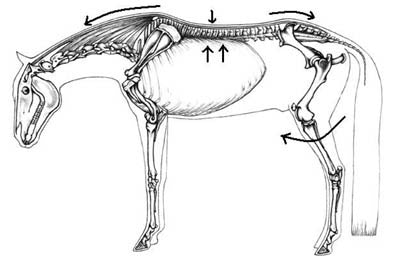
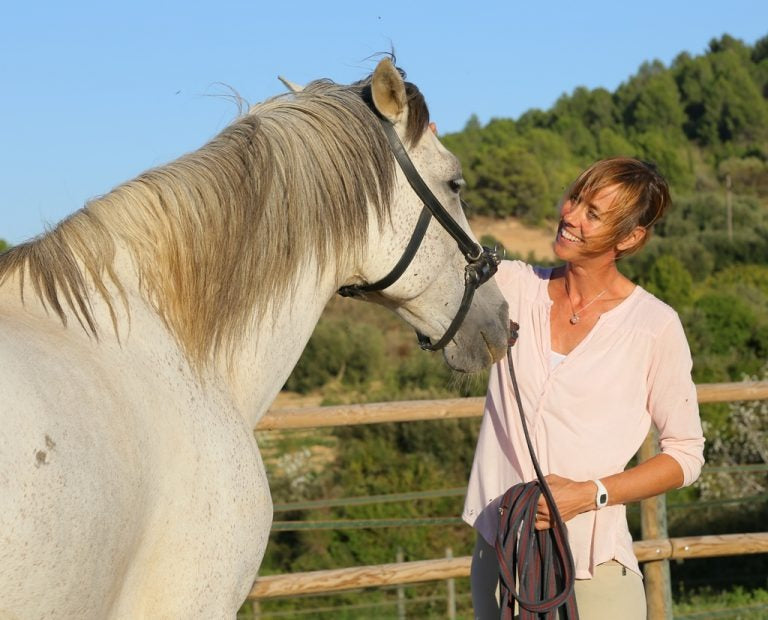
"In equestrianism, it is often said that the horse has one more difficult side than the other...
but the reality is that we riders are the ones who suffer from many asymmetries and imbalances that negatively influence the horse.
Therefore, before correcting the horse, we must correct ourselves because, can you imagine doing sports correctly with an unbalanced backpack on your back, which weighs more on one shoulder than the other?
Becoming aware of our asymmetries is important for the rider to know when something depends on the horse and when it depends on them.
We can do this with exercises independent of riding, among which I distinguish two types:
1. Exercises that strengthen your body, with which you achieve an improvement in your physical condition to be able to later perform good riding.
2. Exercises without a horse that help to become aware of your asymmetries and how to correct them in synchronization with the animal's movement.
Without this second part of exercises without the horse, which are not about building muscle, but about exploring and becoming aware; training the first part of muscle groups will only create tension.
We must know when to use a muscle in riding and with what tone.
Some common asymmetries are those due to the rider always having one side more dominant than the other:
1. Lateral torso collapse -
On the one hand, learn to position the torso well and guide the rider to bring the movement to the collapsed side.
You can also use a whip or stick above your head to help stretch the collapsed side. The process will help the body find straightness.
If you do it on horseback, it is important that someone leads you.

2. Putting more weight on one seat bone -
One of the most common.
A classic Centered Riding exercise to correct it is to ride raising the arm on the side of the seat bone that tends to be in less contact.
It is important to raise the arm following the line of the navel-sternum-nose and with the thumb backward.
Ride like this at a walk and let the horse's movement help stretch this side.

3. Twisting against the horse's direction -
This is equivalent to a horse that always puts more weight on one shoulder than the other (concave, convex).
To explore this, you can sit on a normal chair or a pilates ball and become aware of which side is harder for you to turn. Gradually turn, slowly and without forcing, to both sides and let the movement help you turn a little better each time to the difficult side. It is then that you can take note of whether your horse does not bend well to one side.
You should never force it, but rather help it find it very slowly. Forcing creates tension and pain, both in you and in your horse."
Thank you very much, Paula, for sharing your knowledge with us and helping us with these exercises to improve the health of both rider and horse, thus also improving the performance of the pair.
More soon.
A hug to everyone!
You can find more photographic material and videos on our Instagram
@empiresapphireequestrian.
Paula is wearing our FIT JACKET.
Available on the website.