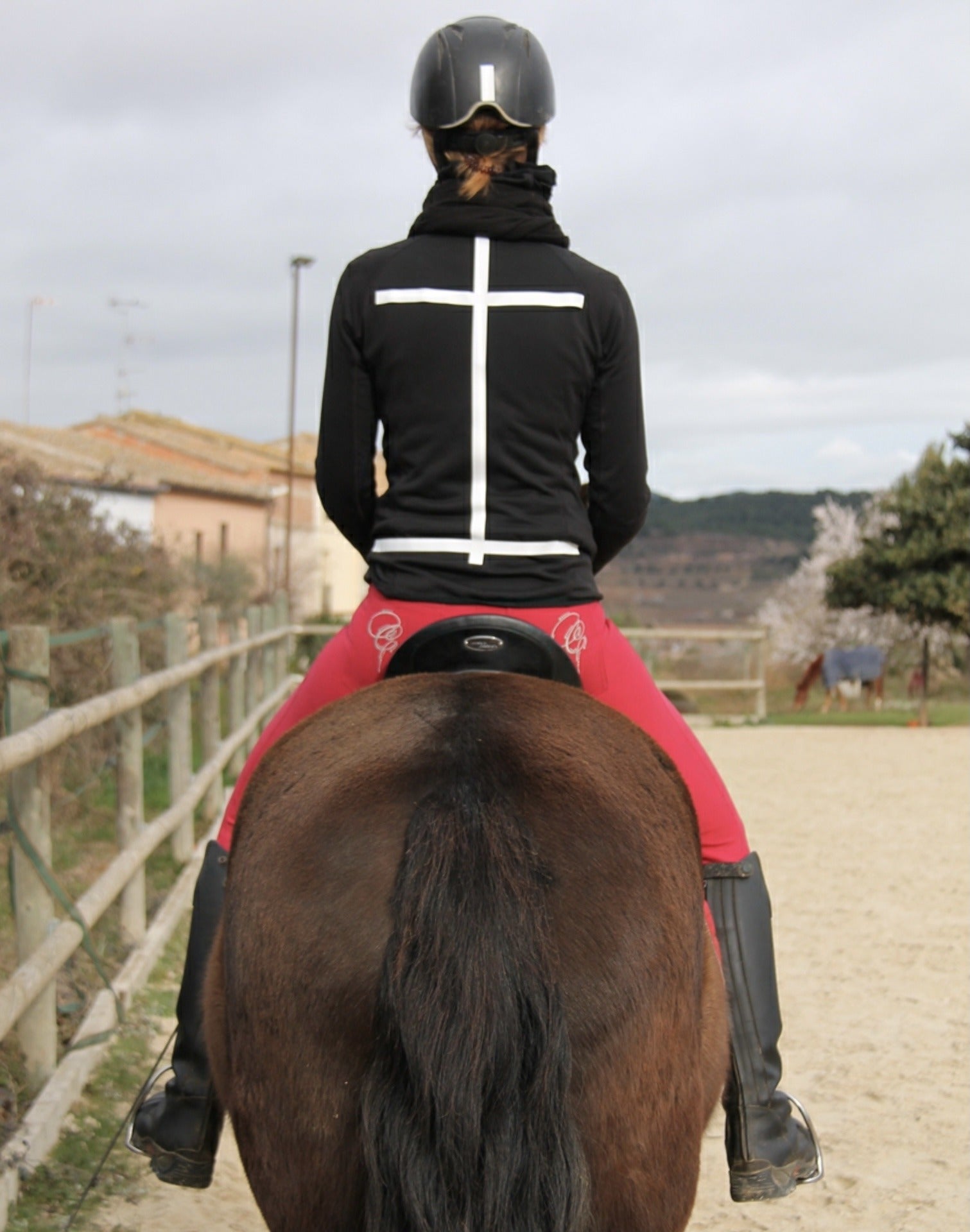
Here we are again!
This time we want to introduce Paula Ohlin, who specializes in riding biomechanics.
Very happy to consider this new collaboration with us, we have asked Paula to give a brief introduction to her work, so that you can more easily understand the rest of the publications, and all the benefits it can bring to yourselves, your horses, and your bond with them:
"Hello everyone! My name is Paula,
I am a riding instructor, specializing in biomechanics.
I work with seat, balance, and movement improvement... I am Swedish and have been working in Spain for 22 years. I run a small equestrian center, Cal Gaudí, south of Barcelona.
It is my hope that more and more riders realize the importance of the way we apply our movements - human biomechanics - in riding.
To realize how much we influence horses with an often incorrect posture and with our lack of understanding of joint movement.
Nowadays, fortunately, more and more importance is given to the biomechanics of the horse and how to train it correctly. There is also talk about rider training in parallel with riding; that the rider must be fit and dedicate time to themselves; but despite this, riding continues to focus on what the horse has to do and what the rider has to make the horse do.
For me, the great void that remains to be discovered is how to combine both - the biomechanics of person and horse - the joint biomechanics of riding, in a healthier and more effective way.
It is in this void that my work begins, spreading the concept “Ride with Feeling”.
“Ride with Feeling” means Riding from feeling. It is not about something “hippie” or doing yoga on the horse - although yoga can also bring many benefits to riding - but rather about the rider becoming aware of how they truly use their body and mind when asking something of the horse and how it influences the joint movement. Becoming aware of how this influences, for better or worse, the horse's ability to do what we ask or not.
“Ride with Feeling” works on posture, seat, balance, and movement. It is about teaching riding by first focusing on what the rider does and what they should do. It is about learning the technique of how to align your body well so that there are no blocks that can hinder the joint work of the pair. It is about learning to use muscle tone and knowing when and where to tone yourself to move with the horse, instead of using tension and working against its movement. After this, it is about learning to use this technique to guide the horse's movements and learning to feel when something is not working because you are not doing it right and knowing how to help the horse when it cannot do it right. Listen to the horse with your body and mind.
This is basic to achieve a successful pair, and for the physical and mental health of the horse. It does not matter if you are a sport rider or a leisure rider, it is necessary to understand that we can really harm horses with poor posture, by not understanding how their movement is and knowing how we should adapt to it.
You must first adapt, then you can ask and guide.
Another great challenge related to this void is making the equestrian world in general understand what a bad posture is and what a good posture is.
There are actually many bad postures that block and prevent the horse from working well, which are accepted as good. Especially in dressage and western riding where an arched back of the rider is seen as a well-aligned back, to give an example; although jumping and leisure and school riding have their versions.
Until now, it is mainly riders who want to improve the well-being of their horse and their communication with them, who seek to learn with me; but it is my greatest wish that sport riding begins to open up to this knowledge, just as is being done in Northern Europe.
Why?
Because in sport riding, whatever the discipline, a lot is demanded of the horses and it focuses mainly on what the horse has to do; but with very little knowledge about the negative influence that the rider has on the horse and the use of tensions and blocks.
How can elastic and beautiful movements be expected from a horse if it also has to carry a rider with an arched back against the movement, with blocked joints and with much use of negative muscular force?
The answer is: first work with the rider's awareness and their understanding of movement.
It doesn't matter the movement, if there is no awareness of it, with the horse."